Paver Patio vs. Poured Concrete for a Triangle Backyard: Which Holds Up?
QUICK ANSWER: In most Triangle backyards, a properly built paver patio holds up better than a poured concrete slab. Red clay swells when it is wet and shrinks when it dries, and a rigid slab tends to crack when the ground underneath it moves. Pavers sit on a compacted stone base and flex with that movement, so a shifted section can be lifted and reset instead of torn out. Poured concrete can still be the right call on very stable, well drained ground or when you want a plain, uniform surface, but either material lives or dies by the base underneath it.
You have a bare stretch of yard behind the house, and you are picturing a place for a table, a grill, and a few chairs. Then the questions start. Neighbors have both kinds of patios, and every one of them has an opinion. One says his slab has a crack running across it after just a few years. Another says her pavers look great but have a low spot near the steps. Both stories are true, and both point to the same thing: in Garner, Raleigh, and the rest of the Triangle, the material matters less than how it meets the ground.
This guide walks through how each surface behaves in our clay soil, our storms, and our winters, so you can decide with real information instead of guesses. We build patios across the area, and the same lessons come up job after job.
Why the Ground Decides Everything Here
Before comparing surfaces, it helps to understand what is underneath them. Most of the Triangle sits on red clay, a dense soil made of tiny flat particles that hold a lot of water. When a summer storm soaks the yard, clay swells. When a dry stretch follows, it shrinks and pulls apart. Any hard surface built on top has to live with that cycle for years.
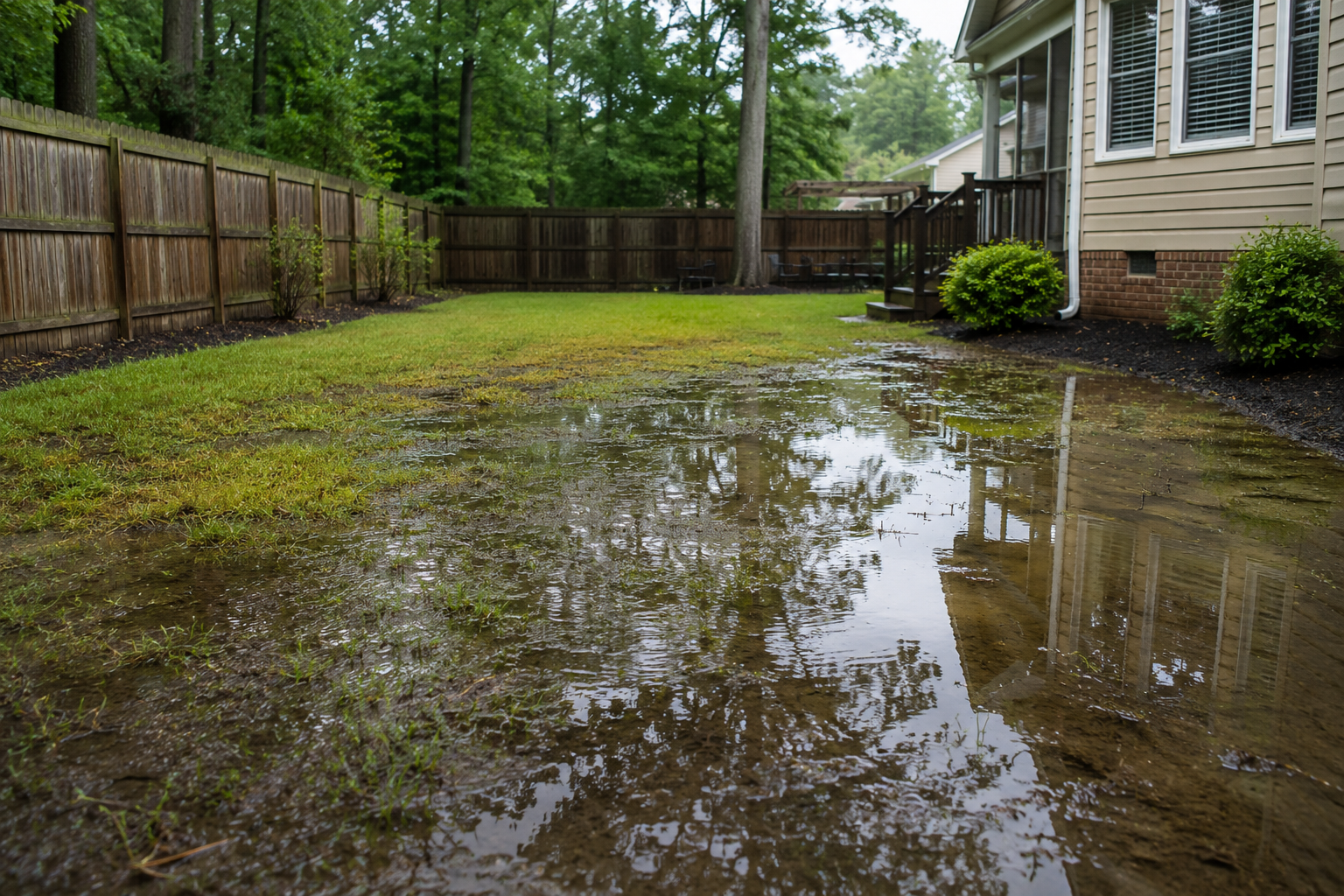
Two things make this worse in a typical backyard. First, new construction often leaves the soil around a house compacted in some places and loose in others, because heavy equipment drove over it and fill dirt was pushed around. Second, the Triangle gets intense downpours in summer, and clay cannot absorb water fast. Water that has nowhere to go sits under and beside the patio, softening the ground in some spots while leaving other spots firm. Uneven support is what causes most patio failures, whatever the surface material.
So the real question is not which material is stronger on paper. It is which one tolerates uneven, moving ground better, and which one is easier to fix when the ground wins an argument with your patio.
How a Poured Concrete Patio Behaves
Poured concrete is one continuous slab. It arrives wet, gets leveled and finished, and cures into a single hard piece. That is its biggest strength and its biggest weakness.
What concrete does well
A slab gives you a smooth, uniform surface with no joints to catch table legs or high heels. It is quick to install once the forms are ready, and on stable ground with good drainage it can last a very long time. It also suits certain designs, like a simple rectangular pad for a hot tub or a clean modern look with minimal pattern.
Where concrete struggles in our climate
Concrete is strong when it is squeezed but weak when it is pulled or bent. A slab resting on clay that swells in one corner and shrinks in another gets bent, and it answers by cracking. Builders cut control joints into slabs to encourage cracks to form along straight lines, but a joint does not stop the ground from moving. It only decides where the crack shows up.
Winter adds another layer. The Triangle does not stay frozen for months the way northern states do, but we get enough freeze and thaw cycles that water sitting in soil under and around a slab can freeze, expand, and settle again. Water can also seep into hairline cracks, freeze, and widen them. Over several winters, small cracks tend to grow and edges can chip.
Then there is repair. When one section of a slab sinks or cracks badly, your options are limited. Patching hides the problem for a while. Lifting a sunken slab is possible in some cases, but a crack that runs through the whole surface never fully disappears. Replacing a section means breaking out old concrete, hauling it away, and pouring new material that will never match the color of the old.
TIP: Whatever surface you choose, stand in the yard during a heavy rain and watch where the water goes. If it runs toward the house or pools where the patio would sit, fix that first. A beautiful surface on top of a wet spot will not stay beautiful.
How a Paver Patio Behaves
A paver patio is a different kind of system. Instead of one slab, you have hundreds of individual units, made of concrete or natural stone, set tightly together over layers of compacted stone and sand. The joints between them are filled with sand that locks everything in place.
What Pavers Do Well
Because the surface is made of separate pieces, it can flex slightly with ground movement without breaking. Water moves through the joints and into the base rather than only running off the top, which helps with our heavy storms. Pavers also come in a wide range of colors, textures, and patterns, so the patio can match the house, the walkway, or the pool deck nearby.
The repair story is the biggest difference. If one section settles, a crew lifts those pavers, rebuilds the base beneath them, and sets the same pavers back down. Stains, a cracked unit, or a spot where a tree root pushed upward can be fixed one piece at a time. Nothing has to be demolished, and the repair blends in because the material is the original material.
Where Pavers Need Care
A paver patio is only as good as what sits under it. The stone base has to be excavated to the right depth, compacted in layers, and shaped so water leaves the area. Skip those steps, and you get exactly the sinking and rocking that give pavers a bad reputation. Edges matter too. Without a firm edge restraint, pavers slowly creep outward under foot traffic and the joints open up.
Joints also need attention over time. Sand can wash out after hard rain, and in humid Triangle summers, weeds and moss find their way into any gap. Occasionally topping up the joint material and rinsing the surface keeps things tight and tidy. It is small, regular upkeep rather than a big repair, but it is a real difference from a slab that you simply sweep.
Side by Side: The Differences That Matter in the Triangle
Movement In Clay
Pavers flex and concrete does not. In ground that swells and shrinks, that flexibility usually wins. On rock solid, well compacted, well drained ground, a slab can perform well.
Cracking
A poured slab may crack somewhere, sooner or later, and the crack cannot be reversed. A paver surface does not crack as a whole, though an individual unit can be replaced if it does.
Drainage
Concrete sheds water off the surface, so the slope has to be right and the runoff needs somewhere to go. Pavers let some water pass through the joints into the base, which softens the effect of sudden storms, though the ground under a paver patio still has to be graded and drained properly.
Repair
Pavers can be lifted and reset. Concrete has to be patched, lifted, or broken out.
Heat And Comfort
Summers here are hot and humid. Any dark surface in full sun gets hot underfoot. Lighter colors help with either material, and pavers come in lighter tones as well as textured finishes that feel more comfortable than a broom finished slab under bare feet.
Looks Over Time
Concrete stains show plainly, and color fades or blotches as the surface ages. Pavers can also fade, but their patterns and texture hide small marks more easily, and stained units can be swapped out.
Slip Resistance
A wet, algae covered surface is slippery no matter the material. In our humid climate, shaded patios under oak and pine trees grow green film quickly. Textured pavers and a regular cleaning routine give better footing than a smooth troweled slab.
Matching the Surface to Your Yard
Some yards lean naturally toward one option.
Choose pavers when your yard has visible clay, a slope, low spots, or recent grading and fill dirt. They are also a better fit when you plan to add features later, like a fire pit, an outdoor kitchen, or a seating wall, because pavers can be lifted and rebuilt around new additions without wrecking the rest of the patio. Any spot near mature trees is a good candidate too, since roots grow and push, and a paver surface can be adjusted when they do.
Consider concrete when the site is flat, firm, and drains well, and you want the simplest possible surface. A basic slab for a small utility area, a pad under a hot tub, or a driveway extension makes sense in the right conditions. Even then, a proper base of compacted stone under the slab, plus reinforcement and thoughtful joint placement, makes a big difference in how it ages.
You can also combine them. Some homeowners use pavers for the main patio and keep a concrete pad for equipment. Others use pavers as a border around a slab, which adds character and helps the edges hold up.
What a Good Base Looks Like
Because so many patio problems trace back to the base, it is worth knowing what a well built one involves, no matter which surface you choose.
First, the crew removes the topsoil and any soft or organic material, digging down to firm ground. Then comes a layer of crushed stone, spread and compacted in stages, not dumped in one thick pile. Each layer gets compacted so it will not settle later. On top goes a thin bedding layer of sand for pavers, screeded flat and sloped slightly away from the house so water heads toward a place it can drain.
Drainage is a design element, not an afterthought. In the Triangle, we often plan for water on purpose, with the right slope, a way to move runoff away from the patio, and sometimes a buried drain line where the yard collects water. Clay drains slowly, so leaving that to chance almost always ends up with a wet patio edge or a soft spot next to the foundation.
The final piece is the edge. Pavers need a restraint along their perimeter to keep them from spreading, and slabs need edges that are supported so they do not crumble or slump. A patio that stays put for many years is one where the edges were built as carefully as the middle.
WARNING: Do not lay pavers or pour a slab straight over topsoil, grass, or loose fill dirt to save a step. Organic material rots and compresses, and loose fill settles unevenly. Within a couple of seasons you will see dips, tilting, and open joints, and fixing it means starting over from the ground up.
Keeping Either Surface in Good Shape
A patio is easier to keep than to rescue. A few habits help in our climate.
Sweep debris regularly, especially leaves and pine needles, which trap moisture and feed moss and algae. Rinse the surface a few times a year, gently, since a hard blast can push sand out of paver joints. Watch for downspouts and irrigation heads that spray onto the patio edge, because constant wetting softens the ground next to it. If you notice a low spot forming, deal with it early. A small settled area is a quick fix on pavers and a bigger headache on a slab.
Sealing is an option some homeowners choose for color and stain resistance, and it can also help hold joint sand in place on pavers. It is a personal preference rather than a requirement, and it works best when the surface is clean and dry first.
Finally, keep an eye on the ground around the patio, not just the patio itself. Mulch beds that slope toward the surface, bare soil that washes across it after storms, and gutters that overflow all send water and dirt where you do not want them.
Frequently Asked Questions
Which lasts longer in North Carolina, pavers or concrete?
Either can last a long time when the base is built correctly. In red clay that swells and shrinks, pavers usually keep looking good longer because they flex with the ground and can be repaired in sections. A slab is more likely to develop a crack that stays for good.
Will a poured concrete patio crack in the Triangle?
It is common for a slab to develop some cracking over the years, since clay soil moves and freeze and thaw cycles add stress. A strong base, control joints in the right places, and good drainage reduce the chances and slow the process, but they cannot promise a crack free surface.
Do pavers sink over time?
Pavers sink when the base underneath was not compacted properly or when water keeps washing the soil out from under them. A well built base and good drainage keep them level. If a section does settle, it can be lifted and reset without replacing the whole patio.
Are pavers slippery when wet?
Any surface gets slick when wet or covered in algae. Textured pavers generally offer better traction than a smooth slab, and regular cleaning keeps shady areas safe underfoot.
Can I add a fire pit or outdoor kitchen to my patio later?
It is easier on a paver patio. Sections can be lifted and rebuilt with the right support for heavier features. On a slab, adding weight or plumbing can mean cutting into the concrete. If you think you might expand later, plan the layout and base for it now.
How do I stop weeds and moss from growing between pavers?
Keep joint sand full, sweep debris off the surface, and clean the patio regularly. Shade and moisture encourage growth, so trimming back overhanging branches and fixing wet spots helps as well.
Is a slab or a paver patio better for a sloped yard?
Pavers generally adapt better, because the base can be shaped and stepped to fit the slope and retaining features can be added to hold the ground in place. Slopes also send water across the surface, so drainage planning matters even more.
The Right Patio Starts With the Ground Beneath
Pavers and poured concrete can both serve a Triangle backyard well, but red clay has a way of exposing every shortcut taken underneath. A slab stays rigid until moving soil bends it into a crack, while pavers flex with the ground and can be lifted and reset one section at a time. For most yards with clay, slopes, or nearby trees, that forgiveness makes pavers the steadier choice, provided the base and drainage are built with the same care as the surface.
Across 10+ years of building outdoor spaces around Raleigh, NC, we have learned that the patios families enjoy longest are rarely the ones with the flashiest finish. They are the ones where the topsoil came out, the stone went down in compacted layers, and summer storm water had somewhere to go. At Greenchest Landscape LLC, that hidden groundwork is where every patio begins, so the table, the grill, and the chairs stay level and steady season after season.