Standing Water in Your Raleigh Backyard After Every Storm? Here's How to Fix Drainage for Good
Rolling terrain sends runoff downhill into low spots and toward houses that sit below grade. A slope that looks gentle and harmless in dry weather can funnel a surprising amount of water during a real storm.
The land is not flat
Grades work against the house
Many yards were left flat, or even tilted slightly back toward the foundation, when they were built. As soil settles over the years, water that should run away from the home instead runs toward it.
Roof water dumped right at the foundation is one of the biggest hidden causes of a wet yard. Carrying that water underground and discharging it well away from the house takes a heavy load off the soil near your walls.
Downspout drainage
Quick Answer: Standing water in a Raleigh yard is almost always caused by heavy clay soil that drains slowly, rolling terrain that funnels runoff into low spots, and grades that send water toward the house instead of away from it. Fixing it for good means finding where the water comes from, not just draining the puddle. A lasting solution usually combines correct grading, French drains, downspout drainage, and surface channels matched to your specific lot. Water that clears within a few hours is fine; water that lingers for a day or more needs a real plan.
You walk out to the backyard two days after a Raleigh thunderstorm, and the same low corner is still holding water over the tops of your shoes. The grass there has gone spongy and yellow, a faint smell hangs over the spot, and you already know the next storm will do the exact same thing.
Standing water that lingers is not just an eyesore. Left alone it drowns turf, carves erosion channels, breeds mosquitoes, and pushes moisture toward the one place you least want it, the foundation of your home. In the Triangle, that puddle is rarely bad luck. It is almost always the predictable result of how water moves through our soil and across our yards, which is also why it can be fixed for good once the real cause is found.
Why Water Sits in Triangle Yards
To fix drainage you first have to understand why our yards hold water in the first place. A few local realities stack up.
Red clay barely drains
The heavy clay soil under most Garner and Raleigh properties holds water instead of letting it soak away. Where sandy loam drinks a downpour, clay sheds it slowly, so water pools on the surface long after the rain stops and stays trapped in the shallow root zone underneath.
We get a lot of rain
The Triangle sees well over forty-five inches of rain in a typical year, often in heavy summer bursts that dump more water in an hour than clay can ever absorb. That volume has to go somewhere, and if the yard is not shaped to move it, it collects.
The land is not flat
Rolling terrain sends runoff downhill into low spots and toward houses that sit below grade. A slope that looks gentle and harmless in dry weather can funnel a surprising amount of water during a real storm.
Grades work against the house
Many yards were left flat, or even tilted slightly back toward the foundation, when they were built. As soil settles over the years, water that should run away from the home instead runs toward it.
Telling a Puddle From a Drainage Problem
Not every wet spot needs a system. The difference shows up in how the water behaves.
How long it stays
Water that clears within a few hours of a storm is doing what it should. Water that sits for a day or more is a sign the ground cannot move it, and that is worth solving.
Where it collects
A puddle in the middle of the lawn is one thing. Water pooling against the foundation, under a crawlspace, or at the base of a retaining wall is another, because that is where lingering moisture does real damage.
What keeps happening
Recurring soggy turf, erosion channels cutting across the yard, mud that never fully dries, and moss taking over shaded low spots all say the same thing. The water has nowhere to go.
Tip: After the next hard rain, walk your yard while it is still wet and mark every spot that holds water with a stake or a bit of flagging tape. Those marks, and how long each spot takes to drain, tell an installer more about your property than any dry-weather description ever could.
Fixes That Actually Work on Clay
There is no single cure for standing water, because water arrives and collects differently on every lot. A lasting fix usually combines a few of these.
French drains
A gravel-wrapped perforated pipe set below grade intercepts subsurface water and carries it to a controlled outlet. On our clay, these are often the workhorse of a drainage plan, and they typically run somewhere between eighteen and thirty-six inches deep depending on the water source and the slope needed to keep it flowing.
Surface grading and swales
Reshaping the ground and cutting shallow, graded channels gives runoff a planned path across the yard instead of letting it wander into low spots. Grading is often the quietest and most effective fix, and the one people skip.
Catch basins and channel drains
Where water concentrates, a basin or channel drain gives it an entry point into a piped system that moves it away from the trouble area.
Downspout drainage
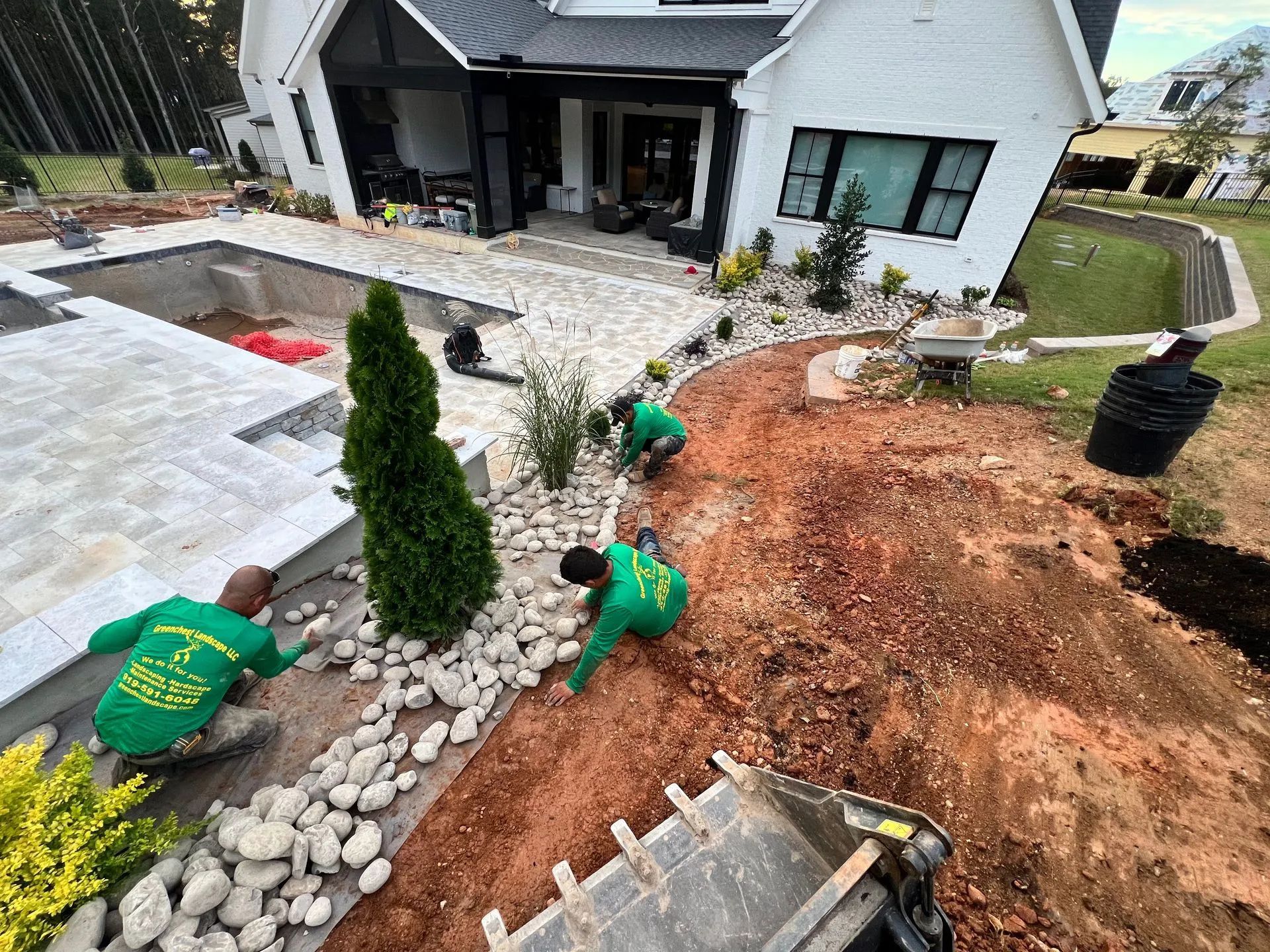
Roof water dumped right at the foundation is one of the biggest hidden causes of a wet yard. Carrying that water underground and discharging it well away from the house takes a heavy load off the soil near your walls.
Dry creek beds
Where a system would otherwise be an eyesore, a stone-lined creek bed can move water and read as a design feature instead of a repair.
Grading: The Fix People Skip
Before any pipe goes in, the shape of the ground around your home matters more than almost anything else. The ground should fall away from the foundation, not toward it. A good rule of thumb is a drop of about six inches over the first ten feet out from the wall, which works out to roughly a five percent slope. That is steep enough to move water by gravity yet gentle enough that you would barely notice it while walking or mowing across it. When that grade is missing, every storm drives water back against the house, and no amount of surface drainage fully makes up for it. Getting the grade right first is what lets the rest of a drainage plan actually hold.
Warning:
Never solve a wet spot by piping water toward a neighbor's property or into a low corner that then floods a foundation, a retaining wall, or a septic field. Water sent to the wrong outlet does not disappear. It becomes a bigger, more damaging problem somewhere else, and often one that is far harder to undo than the puddle you started with.
What a Real Assessment Looks Like
Good drainage work starts with a diagnosis, not a shovel. The right approach is to walk the property, ideally after rain, and watch where water enters, where it pools, and where it wants to go on its own.
Follow the water, not the symptom
The wet spot you see is often downhill from the real source. Tracing runoff back to where it starts is what separates a fix that lasts from one that just moves the puddle a few feet.
Match the system to the site
Clay, slope, outlet options, and how your hardscape sits all decide which combination of drains and grading will work. A plan built around your actual lot beats any generic fix.
Plan around what is already there
Patios, walls, beds, and lawn can usually be worked around, and disturbed areas restored, so the finished yard looks whole again.
Frequently Asked Questions
Why does water sit so long in North Carolina clay soil?
Clay consists of fine, tightly packed particles water struggles to pass through. Rather than soaking in like sandy soil, rain sits on the surface and shallow root zone until it evaporates or runs off, staying soggy for days.
How deep should a French drain be in a Raleigh yard?
Most residential French drains run eighteen to thirty-six inches below the surface. Depth depends on where water originates, how soil behaves, and slope needed to keep water moving toward its outlet, matched to the site.
Will a French drain fix water against my foundation?
It can be part of the answer, but foundation moisture usually needs more than one measure. Correcting grade, carrying downspout water clear of walls, and adding subsurface drainage often work together to keep water away.
Do downspout extensions really make a difference?
They make a large one. A roof sheds enormous water volume, and dumping it at the foundation saturates soil exactly where you want it dry. Carrying that water underground and releasing it away is highly effective.
Can drainage work be done without tearing up my whole lawn?
In most cases, yes. Subsurface systems need narrow trenching, and disturbed areas get restored afterward. Solutions like dry creek beds and stone channels can even become attractive features within existing landscaping.
How soon after a storm should my yard drain?
Surface water should generally clear within a few hours once rain stops. If low spots hold water for a day or more, or the same areas stay soggy repeatedly, a drainage plan is worth considering.
Solving the Puddle for Good, Not Again
Standing water has a way of teaching homeowners patience they never asked for. You rake, you reseed, you throw down a load of topsoil, and the next storm undoes all of it because the underlying problem, where the water comes from and where it has to go, was never addressed. The reason drainage can be solved for good is that water is predictable. It follows grade and gravity every single time. Greenchest Landscape LLC has spent 10+ years reading exactly how it moves across Raleigh, North Carolina.
Once someone traces that path and shapes a system around it, the low spot that has frustrated you for years simply stops filling. Grading, French drains, downspout extensions, and surface channels all play a part, but only when they are matched to the actual clay, slope, and outlets on your property. A yard built around how water really behaves stays dry through the next storm and every one after it.